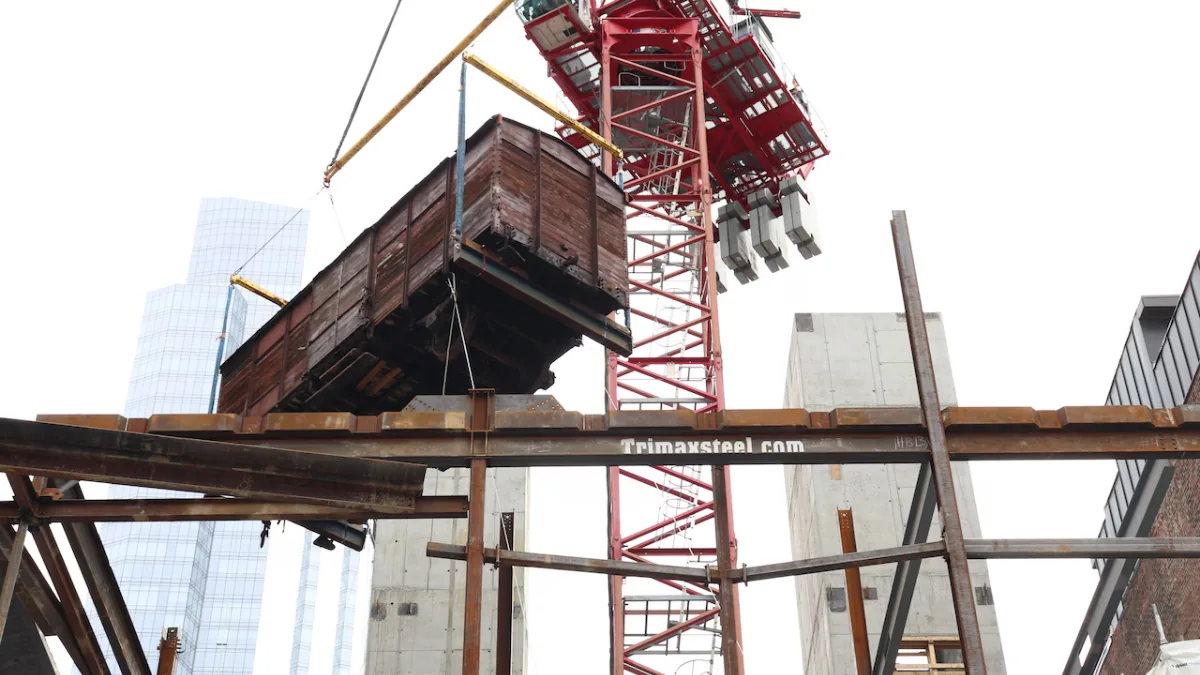
Traffic on Tremont Street slowed, passersby glanced up and a sea of cellphones pointed skyward on Tuesday morning when a crane lifted a historic railcar into the construction site of the new Holocaust Museum Boston — set to open in late 2026.
The railcar, weighing more than 12 tons and more than 30 feet in length, will be a focal point of the city’s newest museum — visible from a protruding fourth-floor bay window facing out to the northeast corner of Boston Common.
Discovered in a junkyard in the Balkan country of North Macedonia, the railcar is believed to be the type the Nazis used to transport Jews and other victims of the Holocaust to extermination camps across Europe, according to the museum.
“This railcar is not just wood and steel. It’s not just an artifact. It’s a witness. A witness carries truth forward when people can no longer speak for themselves,” said Jody Kipnis, the CEO, president and co-founder of Holocaust Legacy Foundation — the group behind the new museum.
People would have been locked inside such railcars from the outside, deprived of food, water, heat and “the basic dignity of being seen as human beings” while they were shuttled against their will in overcrowded conditions, Kipnis added.
Due to its sheer size, the museum said the “meticulously restored” railcar could not be installed after the structure’s final build-out. Therefore, the decision was made to construct the building around the railcar instead.
Once construction is completed, the railcar will be viewable from street level, though partially obscured by the building’s exterior walls and cladding.
The design aims to present a visual effect in which passersby see museum visitors enter the railcar from the window, but do not see them exit.
The museum called it a “visible reminder of the millions of Jews who were transported to their deaths in railcars just like this one.”
The Nazi-era railcar was donated to the museum by Sonia Breslow of Scottsdale, Arizona, who has a personal connection to the Holocaust and to the region.
Breslow’s father, Joseph Polonski, was a survivor of the Treblinka extermination camp in Poland — where hundreds of thousands of Jews were systematically brought by railcar and killed by the Nazis.
Less than 70 Jews survived Treblinka, according to Kipnis. Polonski was among the few who were able to successfully escape the camp.
He later immigrated to Boston after World War II, rebuilding his life in Massachusetts.
The city’s famed Freedom Trail passes the Holocaust Museum Boston site.
Kipnis said the visibility of the railcar will force people to confront “the cost of indifference,” which remains relevant into today’s world.
“The Holocaust was not carried out by Nazis alone,” Kipnis said. “It was carried out by people. Ordinary people, who kept the trains running, who stamped the papers, who followed schedules, who chose silence over courage.”
“The machinery of genocide ran because countless individuals did their everyday jobs and looked away,” she added.
“This railcar asks each of us, when we see hatred, will we speak? When we witness injustice, will we act? When silence feels easier, will we choose courage instead,” Kipnis said. “This is not just a relic. It’s a call to conscience. It’s a warning.”
Other museum exhibits will include an interactive experience called “Dimensions in Testimony,” in which visitors engage in conversations with holographic-like representations of Holocaust survivors based on pre-recorded interviews.
Rick and Janice Lipof, members of the museum board of directors present for the milestone, said the railcar had always been central to the museum’s design since its inception.
Rick Lipof added that the building’s top two floors will be spaces designated for meetings and education with a direct view to the golden dome of the Massachusetts State House.
The couple indicated that the museum’s location, a prime downtown site close to the seat of democracy in the Commonwealth, was very much intentional.
Located at 125 Tremont St. — just steps from the Park Street MBTA station — Holocaust Museum Boston said it will be the only museum in New England to be fully devoted to Holocaust history and education.
Holocaust Museum Boston is notably a separate entity from the six glass pillars of the New England Holocaust Memorial, situated next to Boston City Hall.