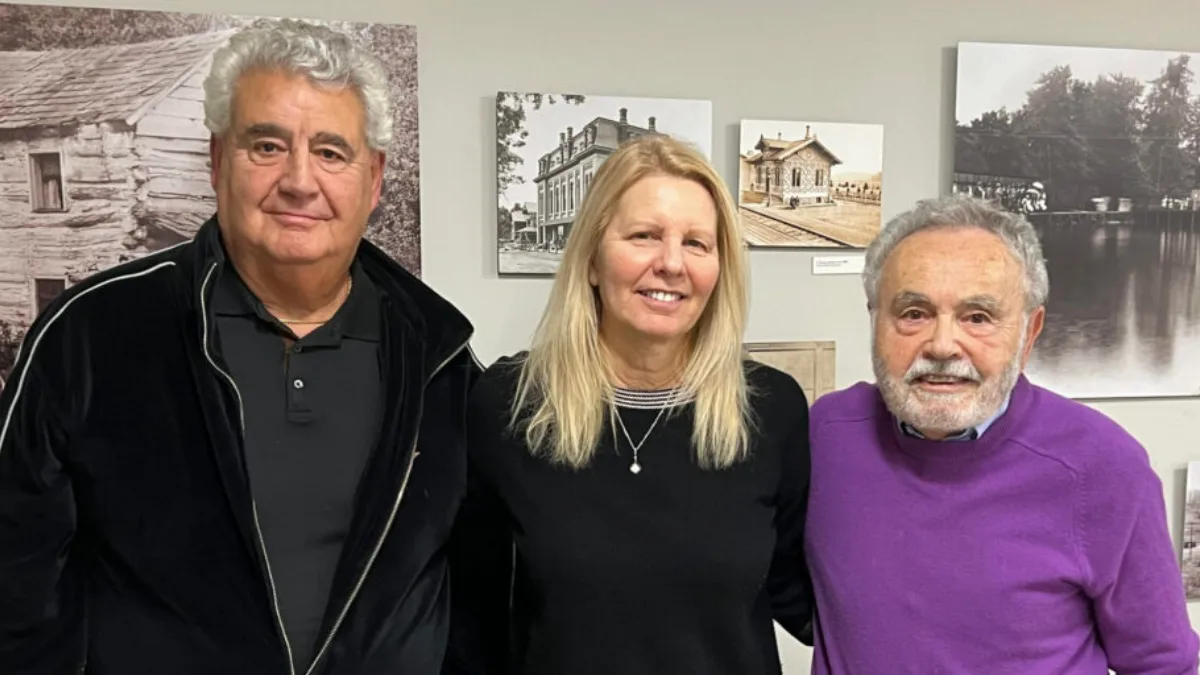
Michael Fryd still has nightmares that he is running down a staircase to escape German soldiers. There’s an opening at the bottom, but he can’t go through, and just as the soldiers are about to reach him, he wakes up.
Fryd, 89, was a child during World War II and escaped the Holocaust mostly through the grit and ingenuity of his mother, Evelyn.
Fryd, a retired DuPont scientist, tells the tale in his memoir “My Mother’s War.”
Fryd is also the subject of a short documentary by Main Line TV filmmakers Jill Frechie and John Riccuitti, which premiered Dec. 16 at Radnor Memorial Library. The filmmakers met Fryd, who speaks about his experiences to students, through the Holocaust Awareness Museum and Education Center in Elkins Park.
“I don’t feel completely comfortable thinking of myself as a survivor,” said Fryd. “I survived because of my mother, not through anything I did. I was a child.”
Fyrd, a Philadelphia resident, spoke to the library audience afterward and answered questions about his experiences surviving World War II, living in Paris after the war, and then immigrating to the U.S. with his parents.
Broad + Liberty asked Fryd about increased antisemitism since the Oct. 7, 2023, terror attack and the recent slaughter of fifteen Jews in Australia as they celebrated the first night of Hanukkah on a beach. Among the dead were a Holocaust survivor who was 87, and a ten-year-old girl.
“I’m used to antisemitism on the right. That has been traditional,” said Fryd. “That killing in Bondi [Australia] is an extension of antisemitism on the left.”
He noted that no students protested the Russian invasion of Ukraine, and more Ukrainians have been killed than Palestinians in Gaza.
“When Oct. 7 happened, it was like a gut punch,” he said. “It reminded me of what happened before.” And comparing the percentages of populations, the 1,200 Israelis murdered by Hamas terrorists are the equivalent of 60,000 Americans.”
But he blames Prime Minister Benjamin Netanyahu’s handling of the war for sparking the increase in worldwide antisemitism and allowing Hamas to gain sympathy from the public. He called antisemitism “a virus that comes to life whenever an opportunity is available.”
Fryd was a three-year-old when German soldiers came to the small town in Poland where his family had a bicycle shop. The Fryds and other Jewish residents went into a ghetto behind a barbed wire fence.
The ghetto was near train tracks, and they saw cattle cars loaded with Jews pass by on their way to Treblinka, a death camp built on his grandfather’s farm. His parents realized that if they stayed in the ghetto, Treblinka would also be their fate.
His mother, who slipped out under the fence to get food, made contact with a farmer who agreed to hide the family for a price. Fryd, his father, Saul, and his mother escaped in the middle of the night, walking six miles to a farm where the farmer hid them in his root cellar for three years, surviving on potatoes and bread. They left behind his grandfather, who could no longer walk, something that haunted his mother for the remainder of her life.
Although he was very young, Fryd has vivid memories of that terrible time. His parents taught him to read, and he read whatever books his mother smuggled in, which “broke down the walls of the cellar” and stimulated his imagination.
“This served me later in life,” said Fryd, who holds a Ph.D. in chemistry and an Ed.D. in group behavior. “People think of scientists as being very logical, but the difference between scientists is whether you can imagine the impossible?” Fryd holds 79 patents and is a DuPont Hall of Fame inventor.
Fryd began writing after he retired from DuPont. He’s published short fiction, and “My Mother’s War” is his first book. A novel, “Eva’s Secret,” will be published in April.
Near the end of the war, the farmer told the Fryds they had to leave the root cellar because it was too dangerous with more German soldiers patrolling. Another farmer then took his father and Fryd in, and they stayed in his back bedroom for a few months, while his mother looked for a safer hideout.
But then German soldiers came and “we thought we were dead.”
“We saw the (bedroom) door handle turn,” he said. “Just as the doorknob was all the way to the right, there was a call from outside. We saw the door handle, like in a movie shot, turn back, and we heard his steps walking away.”
After the Fryd family reunited, again on a Polish farm, German soldiers came, but they pretended they were Catholics. A German captain was very taken with his mother, who had claimed to be a war widow, and went on romantic walks with her, while his dad had to remain silent, Fryd said.
The book details many near misses when Evelyn Fryd’s daring and resourcefulness saved them repeatedly.
But after the war, his parents placed Fryd into two orphanages so he could be around other children. He said he felt abandoned. However, the family lived together in Paris until getting visas to come to the U.S. It took ten years for his father, who had learned how to create purses in Paris, to find a job at a factory in the U.S. His mother’s continued resourcefulness helped the family, which by then included a younger brother born in America, to survive.
Fryd and his wife, Susan, had four children, but their son and daughter-in-law died tragically in a traffic accident. Three daughters survive.