The Living Memory exhibition brings individual experiences to the fore with deeply personal effects from the museum’s vast archives
By Zev Stub, Times of Israel, November 13, 2025. Click for full report and photographs.
A new exhibition at Yad Vashem, the World Holocaust Remembrance Center, puts hundreds of personal possessions and artifacts from Holocaust survivors, most never before seen by the public, on display for the first time. Entitled Living Memory, it offers a fresh and personal look at the lives of individuals whose stories were lost in the mass murder of six million Jews.
“This exhibition is really about memory — how we preserve it and transmit it, and how it shapes our identity and culture,” explained Eliad Moreh-Rosenberg, chief curator of the exhibit.Keep Watching
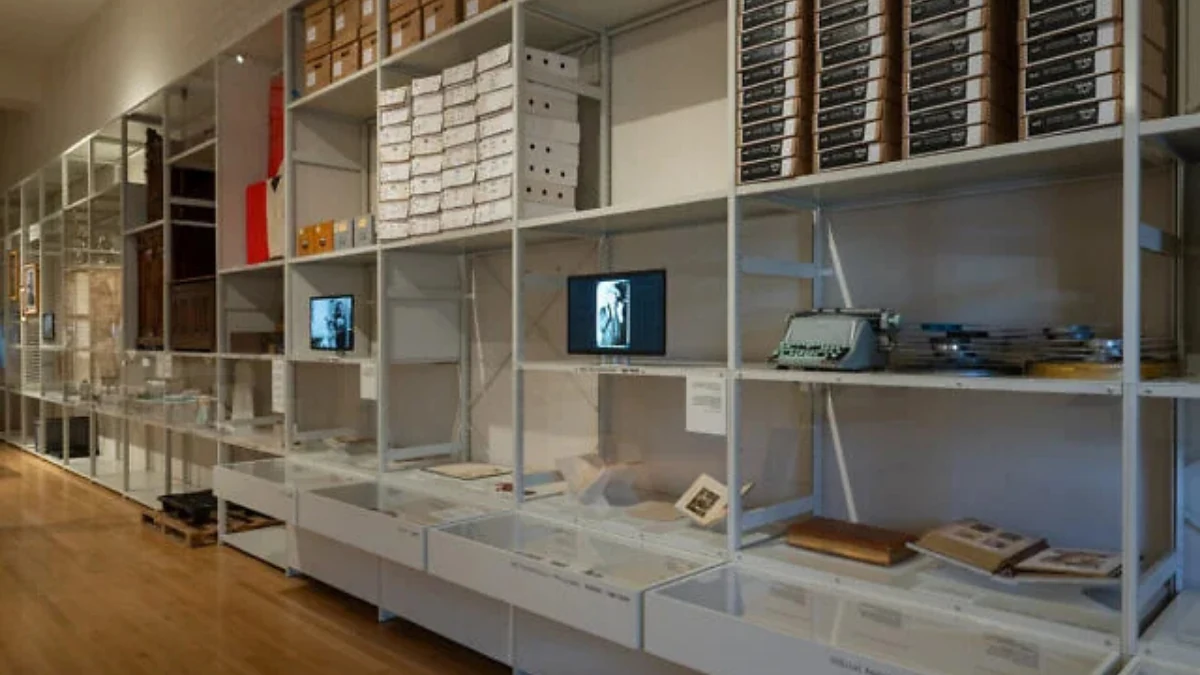
Items were curated from Yad Vashem’s vast collections center, which includes a five-story building housing millions of pages of documentation and tens of thousands of artifacts gathered over the years, including artwork, photographs, testimonies, personal items and much more. The exhibition is scheduled to continue indefinitely.
“These treasures are carefully stored using the best preservation techniques available, but we didn’t want them to be hidden from the public,” Moreh-Rosenberg said. “The vision was to display these in a way that brings their stories out into the open.”
Two years in the making, the exhibition opened to the public this week, at the same time as Yad Vashem announced that it had reached the milestone of recovering five million names of Jews murdered in the Holocaust. The names of the remaining one million Jewish victims will probably never be known, Yad Vashem said, although new technologies may make it possible for as many as 250,000 more to be uncovered.
Because the exhibit focuses more on personal testimonies than the unfathomable historical events that shaped the Holocaust, it is somewhat more appropriate for children than some of the other memorials in Yad Vashem, Moreh-Rosenberg said. However, parental discretion is still advised.

Symbols of survival
The exhibit opens with a series of personal items with stories of survival.
One of the first is a wardrobe where Genia Sznajder, a Jewish girl in her teens, hid from the Nazis during a roundup in Poland in 1941. When a Nazi officer asked the non-Jewish owner of the house for the key to the wardrobe so he could check whether someone was inside, she said the key was lost. Unconvinced, the officer stabbed his bayonet through the door, striking just above Genia’s head. Years later, Genia’s daughter met with the home’s owners and arranged for the wardrobe, still with the bayonet hole in the door, to be donated to Yad Vashem.
Next to that are pieces from a massive tree trunk from a Czech village where 20-year-old Jakob Silberstein hid after escaping a death march. After he saw a rabbit enter a hole at the bottom of the tree, Silberstein realized the tree was hollow, and was able to widen the opening so he could hide inside. Decades later, he returned to the village and found the tree, which he cut into parts to bring to Israel.
Nearby is a Shabbat candelabra that Azriel Yitzhak Shöner created from barbed wire while a prisoner at the Mauthausen concentration camp. He would use it to light wood chips to mark Shabbat, according to a story he only shared later in life, when he was on his deathbed.
An original list compiled by Oskar Schindler of some 1,100 Jewish prisoners he saved in Brünnlitz is displayed. So is a handwritten Rosh Hashanah prayerbook written from memory by Cantor Naftali Stern using a pencil and paper he purchased in exchange for a ration of bread.
The original list compiled by Oskar Schindler of some 1,100 Jewish prisoners he saved in Brünnlitz, displayed in Yad Vashem’s Living Memory exhibition (Yad Vashem)
Other artifacts include a picture book illustrated by a survivor showing the steps her family took to hide from Nazis, and a mangled spoon that absorbed a bullet intended to kill a young man after he jumped off a train to escape deportation.
After these, the exhibition shifts focus to explore the different ways that survivors chose to bear witness to their experiences.
This section includes a space dedicated to the famous trial of Nazi Party leader Adolf Eichmann in 1961, as well as numerous artistic creations.
In one, artist Shulamit Levin, born in 1940 in Będzin, Poland, reimagines biblical Joseph’s coat of many colors as a frayed prisoner’s shirt scarred with identification numbers and flower petals.
In another, artist Ruth Schloss painted Anne Frank as a concentration camp prisoner, with her head shaven and wearing a prisoner’s uniform.
“One of the reasons Anne Frank has become such a popular symbol of the Holocaust for so many is that she is seen from her diaries as a smiling young girl, without us knowing the terrors she may have endured afterwards,” Moreh-Rosenberg said. “With this, the artist imagines her going through more of the terrible experiences that she herself endured.
A final portion of the exhibit is dedicated to exploring several iconic symbols that have shaped the collective memory of the Holocaust. Among these are piles of yellow Star of David patches to be distributed to Jewish families in France and a Hitler Youth flag captured by US Army soldiers and signed with taunting messages.

Inflection point
The launch of the exhibit comes at a time when Yad Vashem and other Holocaust memorial institutions are developing new strategies to keep the lessons of the Nazi’s planned genocide of the Jewish people relevant for a younger generation. At a time when fewer survivors remain alive to give personal testimony, antisemitism is rising worldwide and misinformation is rampant online in the aftermath of the October 7, 2023, massacre, when Hamas launched its war against Israel.
Yad Vashem has launched several other installations in recent months, testing new educational approaches. These include an audiovisual show depicting Jewish life and culture in Europe before the Holocaust in its Valley of the Communities monument, as well as a new immersive theater for kids dramatizing the stories behind some of the museum’s most unique artifacts.
Moreh-Rosenberg said that the national trauma of October 7 has not overshadowed or diminished the public’s interest in Holocaust history.
“It’s the reference point we all look to as we try to make sense of what happened,” Moreh-Rosenberg said. “Many survivors of October 7 and their families have said that the collective memory of the Holocaust is what helped keep them strong during this time. That’s why we have to keep teaching about it.”