By Alex Barton, Fox 2, April 25, 2026. Click for full report.
CHESTERFIELD, Mo. — A new public art exhibit in The District of St. Louis is bringing Holocaust history out of museums and into everyday life, inviting visitors to confront the past face to face.
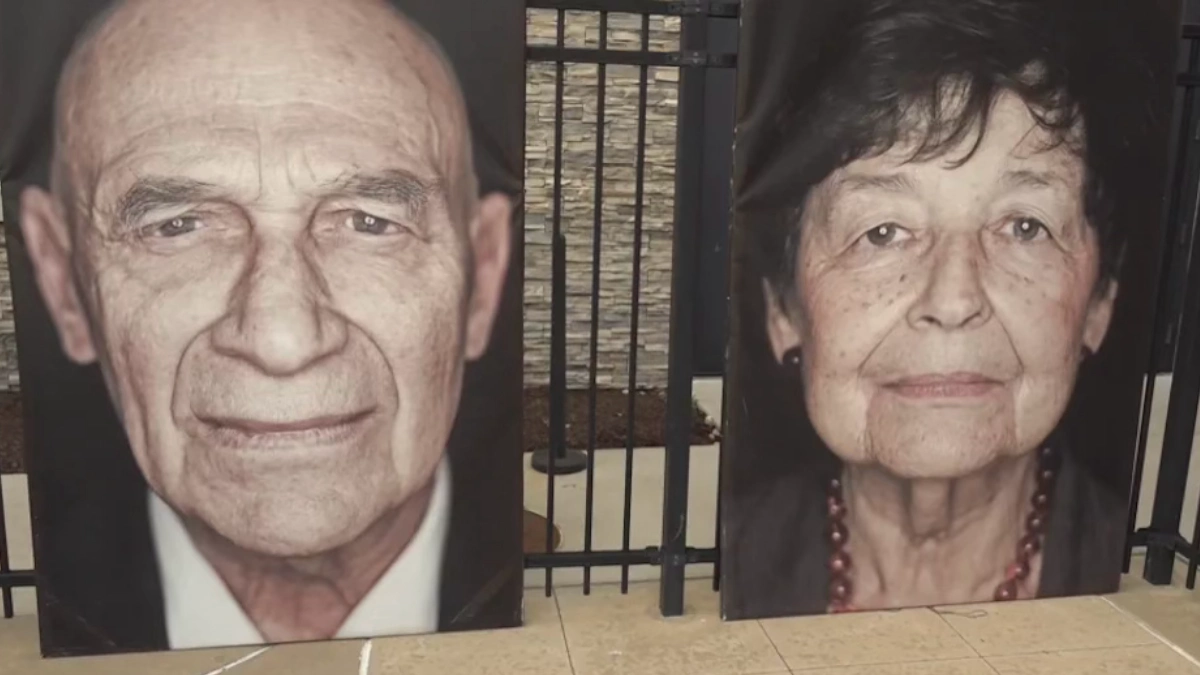
“Lest We Forget,” created by German photographer Luigi Toscano, features more than 70 large-scale portraits of Holocaust survivors displayed along walkways in the outdoor shopping and entertainment complex. The exhibit is free and open to the public through May 3.
Toscano, a photographer and filmmaker, has spent more than a decade documenting survivors around the world. He said the project is intentionally simple in its design but powerful in its impact.
“The first is that they have to see them in the eyes,” Toscano said, explaining that visitors often recognize the weight of the images before reading any captions.
Each portrait is set against a black background and printed at a large scale, allowing viewers to stand directly in front of the subject. Toscano said that moment of eye contact is central to the experience.
“If you stay in front of them… and look them in the eyes… something happens with you,” he said.
Over the past 10 years, Toscano has photographed more than 600 survivors across multiple countries. He said every story has left a lasting impression.
“Every single story touched me really deep,” he said.
One story that stands out to him is that of a woman he met in Paris named Arlette. After World War II, her family waited daily at a train station for her father to return from a concentration camp. Months later, they learned he had died. Shortly after receiving the news, her mother took her own life. Arlette was nine years old at the time.
Toscano recalled her telling him she had to grow up instantly after losing both of her parents.
Toscano said the exhibit is designed to reach people who might not otherwise seek out Holocaust education. Instead of placing the portraits in museums, he installs them in public spaces with heavy foot traffic.
“The trick is I go to the people,” he said.
He has displayed the work in cities around the world, including along the National Mall in Washington and in public parks in Boston, where commuters encounter the portraits during their daily routines.
He said sparking curiosity is the goal.
“When they ask this question… I win,” Toscano said, referring to visitors who begin wondering about the people in the portraits.
The Chesterfield exhibit also marks the first time the project has been paired with classroom programming in the United States. Organizers have expanded the exhibit to school grounds, aiming to engage younger audiences directly.
“And also… we bring this also now for the first time in America on the schoolyards,” Toscano said.
He said that effort is critical, citing a lack of awareness among younger generations.
“More than 40 percent of the younger generation… they don’t know nothing about the Holocaust,” he said.
The exhibit includes QR codes that allow visitors to learn more about individual survivors and their experiences. Toscano said the goal is not only to inform but to encourage continued learning.
“You can learn every day,” he said.
He also emphasized the urgency of preserving these stories as the number of living survivors declines. His motivation, he said, is rooted in a message he has heard from survivors themselves.
“If you forget the past, we are… doomed to repeat it,” Toscano said.
Organizers say they hope the exhibit sparks conversation among visitors of all backgrounds, even those who may initially approach it with skepticism.
“That is beautiful when the people start to discuss,” Toscano said.
“Lest We Forget” is supported locally by the nonprofit organization Conversation Builds Character and other partners. Toscano said the project would not be possible without that support and emphasized that it is not a commercial effort.
“I think it is necessary… to say thank you to the people who support this,” he said.
As visitors move through the exhibit, Toscano said each person may walk away with something different. What matters most, he said, is that they continue to engage with the history and keep learning beyond the exhibit itself.