Article originally written by Allison Hanes and posted on The Montreal Gazette.
Rethought art collection will be a “powerful vector to broach difficult subjects” at its new home on the Main.
Donning white gloves, Marie-Blanche Fourcade disappears down a narrow aisle of floor-to-ceiling shelves in the vault-like room of a special facility where the Montreal Holocaust Museum stores many of the 15,000 objects and documents in its collection.
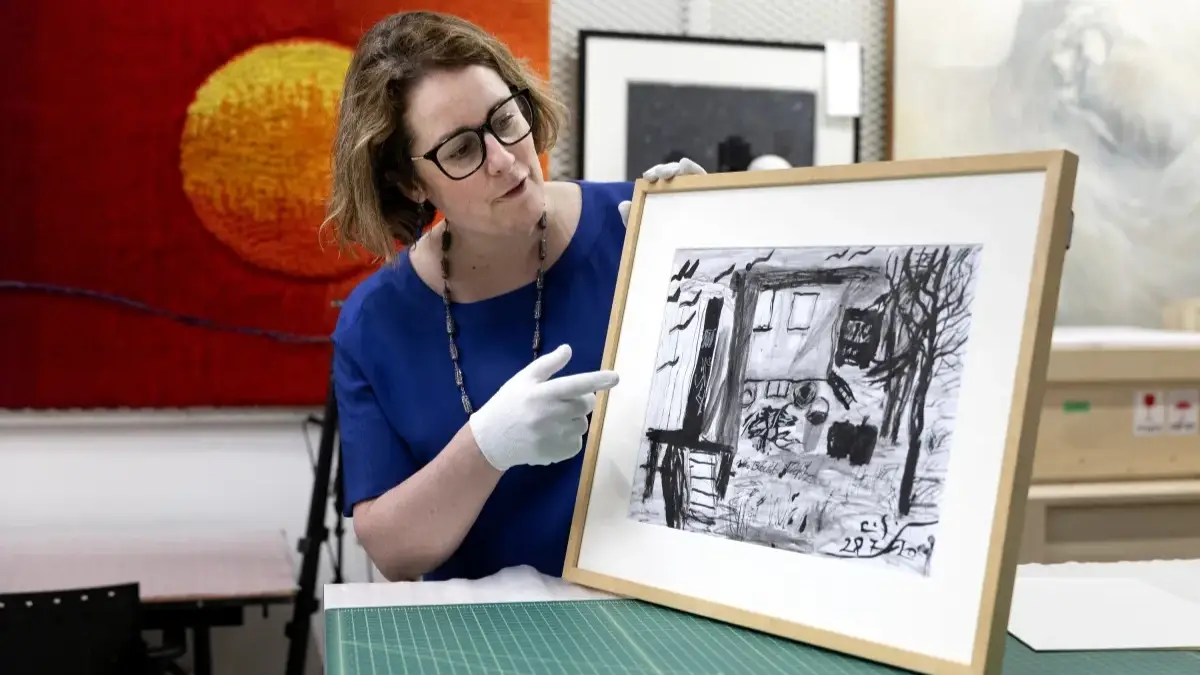
She emerges moments later with a drawing by Ceija Stojka, a Roma artist who survived Auschwitz as a child, entitled What remains? Nothing.
In slashes of inky black, the piece depicts the remnants of a caravan, charred trees, a jumble of pails, and birds that appear like harbingers of doom. It provides a rare recounting of the Holocaust from the Roma perspective.
“Her work is usually very colourful, especially when she treats life before. But this is very, very dark,” explains Fourcade, head of conservation and exhibitions at the Montreal Holocaust Museum. “She’s speaking to the violence through her painting. She succeeds in transmitting the power of her testimony through her works. … It’s really hard to portray a subject like this, so it’s really exceptional to have a Ceija Stojka work in the collection.”
Like most of the art the museum possesses, Stojka’s drawing is not usually on display at an institution dedicated to commemorating one of the darkest chapters in history.
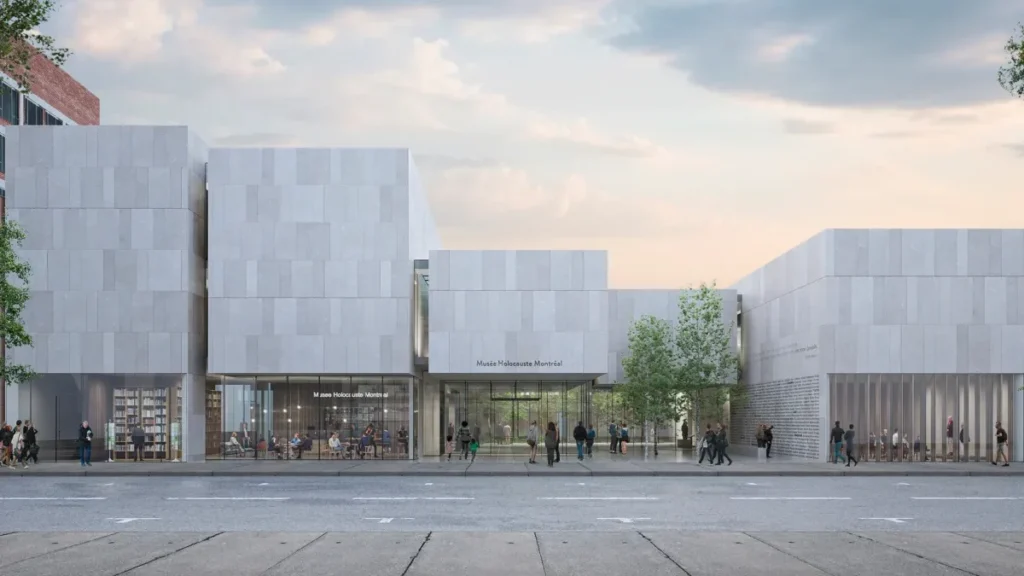
But that will soon change when the museum opens the doors of its brand new home on St-Laurent Blvd. next year.
In fact, the move from Côte-des-Neiges to the heart of Montreal and the construction of a new building on the Main are prompting a complete overhaul of the museum’s permanent exhibition.
To help undertake this transformation, the museum brought in a renowned architectural historian and Holocaust scholar on contract as a co-curator to work alongside Fourcade.
“After an exhibit that lasted 23 years, we have the opportunity to rethink what we’re doing,” Fourcade said. “We have this very exciting moment where we need to come up with an exhibit that’s going to last for the next 15 years. It’s not just thinking of what we’re doing today, not just looking at your feet. You have to look ahead and say ‘What should we do?’”
Actually, Robert Jan van Pelt, a professor at the University of Waterloo, was first conscripted by KPMB Architects, one of the firms that ended up winning the contest to design the new museum.
He ensured that a curatorial perspective was part of the conceptualization process from the outset and insisted that the Holocaust not be represented in the design of the building itself. Instead, he wanted to bring glimpses of the street outside into the new museum.
After an exhibit that lasted 23 years, we have the opportunity to rethink what we’re doing.
Marie-Blanche Fourcade
Co-curator
“The Holocaust is basically about a society that destroys itself and for me it’s very important that we show in the building … a city that works,” van Pelt explained. “Every time you move then from one section to the next section of the exhibition, you can look out into the street. You can see life as it unfolds in the here and now, which is a response to the horrors of the Holocaust.”
He said the building from the street should be quite “neutral.”
“The most important thing to me is to restore the urbanistic continuity of St-Laurent, because it’s a very important street in Jewish history and especially at the point north of Sherbrooke where the building was going to rise on a parking lot.
“What our building does is it repairs in some ways the fabric of the street. That is going to be its most important function and that, in a kind of fundamental way, is its response to the Holocaust, one of repair, not one of representation. If we do any representation, we do it in the permanent exhibition.”
Van Pelt’s vision for the building is now helping reshape the museum’s approach on the inside.
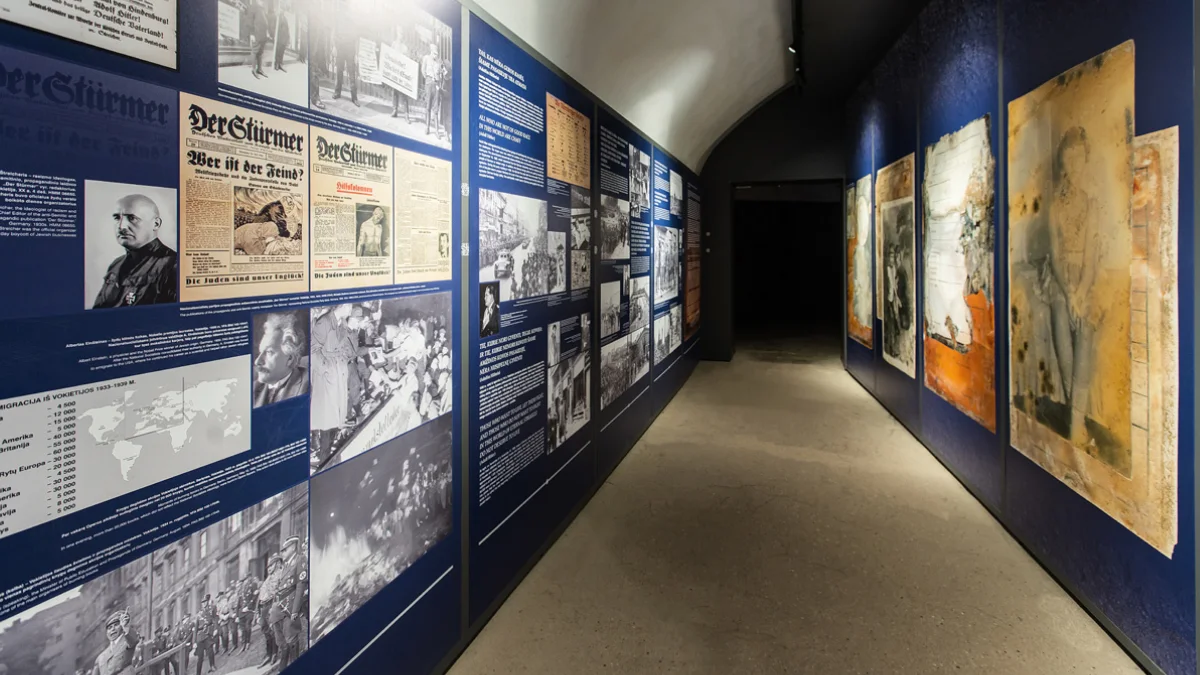
Instead of being arranged chronologically, for instance, the exhibits will be organized by theme, examining the breakdown of institutions, the impact on interpersonal relationships and the toll on the self.
“The fact that we do not have a chronological exhibition is really unique in the history of the representation of the Holocaust,” said van Pelt in an interview. “We are very much foregrounding the kind of equivalence between artifacts and testimony.”
More of the thousands of objects donated by survivors and their descendants will be showcased. Many will be displayed in glass boxes on their own so they can be appreciated from diverse angles and more intimate perspectives.
Audio testimonies of as many as 90 survivors will narrate the journey through the museum at a time when living witnesses to this history are dying off.
But the museum will otherwise embrace “digital sobriety,” said van Pelt in hopes of forging a deeper human connection in an era of constant scrolling and distraction.
Another cornerstone of the plan is to give art more prominence, offering a fresh way to transmit the history of the Holocaust and adding another dimension to the experience of visitors.
Works commemorating the Holocaust that are already part of the museum’s holdings are being selected from the vault. Other important pieces are being borrowed, sought out and commissioned in order to fit with this grand vision for the museum.
There will be art by witnesses to the Holocaust or their descendants, world-renowned masters and major Québécois artists to show how the histories of different peoples, places and time periods are tightly interwoven.
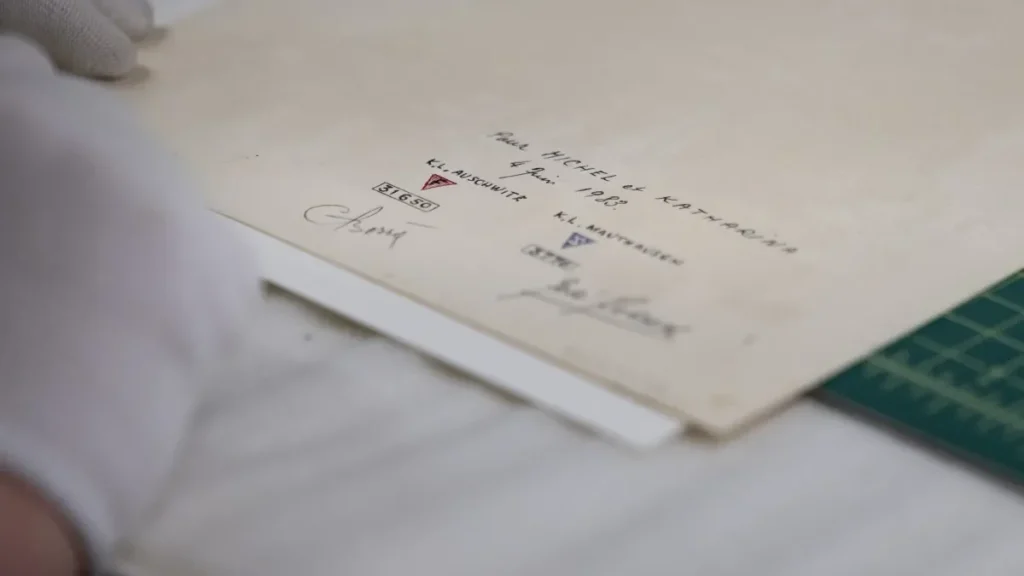
There is a Chagall as well as a Picasso donated by survivors who inscribed their prisoner numbers on the back, adding to the lithographs’ historical significance.
“These artists are a cornerstone of commemoration,” said Fourcade. “They contributed to making it something that concerns everyone. And when artists express themselves on a subject, to me at least, it says that all of society takes it to heart.”
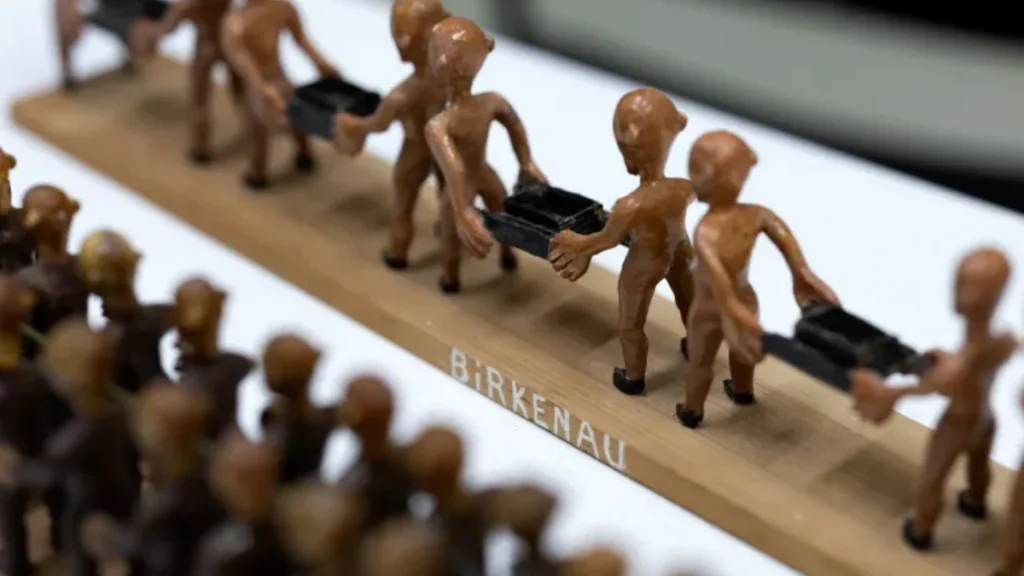
On a recent visit, Fourcade also brought out two wood carvings by Felix Kohn, a self-taught artist who whittled incredible pieces in his garage near St-Laurent Blvd. once he moved to Montreal after the war.
A survivor of the Jaworzno and Birkenau concentration camps, his carvings bear witness to forced labourers chained together and prisoners full of despair.
“I find these (carvings) very articulate when we talk of the subjugation of the individual,” said Fourcade. “It’s a very powerful manner to express all kinds of emotions.”
The museum will also be installing a floor-to-ceiling stained-glass work by renowned Quebec artist Marcelle Ferron.
The Permanent Memorial for the Six Million Jewish Martyrs of the Nazi Holocaust was completed in 1970 after Samuel Bronfman commissioned it to grace the headquarters of the Canadian Jewish Congress building at the intersection of Côte-des-Neiges Rd. and Docteur-Penfield Ave. Concordia University now owns the building and is selling the property.
A decision was made to gift the Ferron piece to the Montreal Holocaust Museum, a natural home given its history and the subject matter.
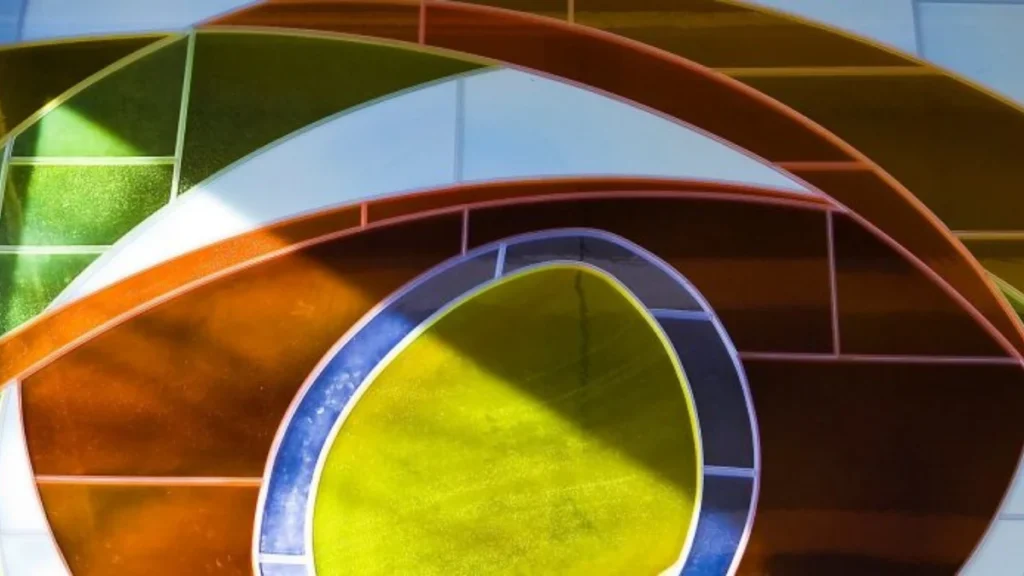
“This is actually a Quebec treasure that is very well-known and revered in Quebec. So we found a place for that, as well,” said Helen Malkin, a consultant and director of planning and development for the new Montreal Holocaust Museum.
But it took some creativity to accommodate Ferron’s sizable masterpiece, since its inclusion came late in the game of the building project.
First they had to figure out where it would go. They came up with a staircase leading to the permanent exhibition, where it will be visible to everyone navigating the museum.
“We need special lighting behind it to give it the sense of stained glass and the sun coming through,” said Malkin.
The piece has been dismantled until construction is finished — which poses another challenge.
“It’s too big to go through corridors and doorways and all that. So we refer to it as the zipper. There’s going to be a little opening on the side of the building that will be left open,” Malkin said. “They’re going to come with cranes and the construction manager and basically hoist it into the stairwell through the outer wall.”
The museum has also commissioned a new sculpture for its rooftop terrace as part of the obligation in Quebec to spend one per cent of the construction budget of major institutions on public art. After a design competition earlier this year, a jury selected Montreal artist Nicolas Baier’s Candelabra to crown the new building.
The piece features stainless steel tubes embedded with points of lights arranged to form the constellations of stars in the night sky over Montreal.
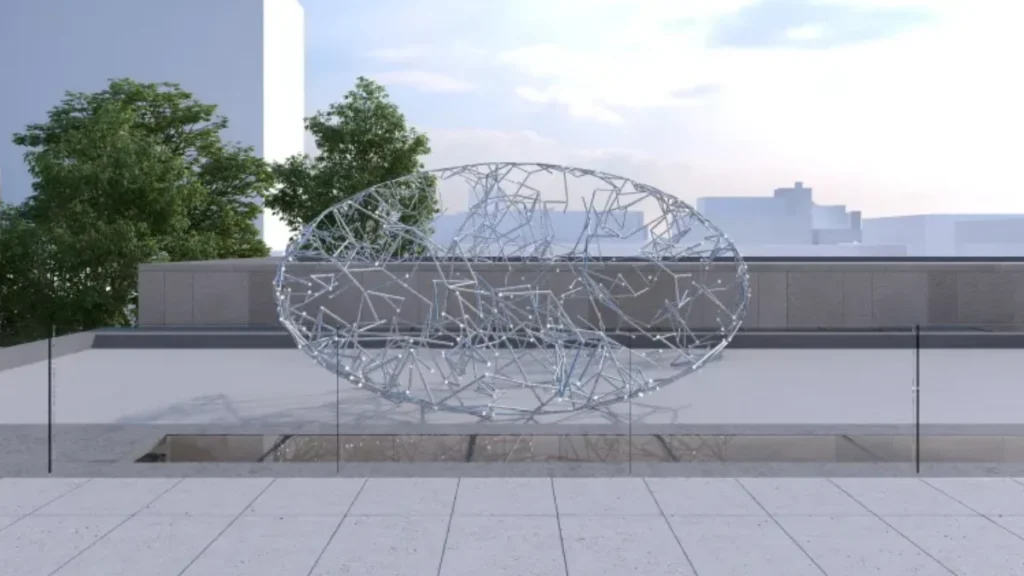
“What the jury felt was that this was the most poetic work, that he really sort of spoke to the idea of being imprisoned and being able to look to the sky, and resilience, the hope of the sky, the hope of freedom,” said Malkin. “The way that he actually designed it is quite beautiful.”
At night and in the more sombre winter months, the illuminated Baier sculpture will be visible from below as visitors make their way up through the galleries.
“The roofscape became very important in this project because the roof of the building has this magnificent view over the skyline of the business district and the Golden Square Mile, but also you have the Plateau and the mountain,” said van Pelt. “On the roof terrace they will see a city that, despite its frictions, is actually a response in its humanity to the Holocaust. So I think that one of the reasons Baier got the job is because his artwork, Candelabra, is in tune with what the building tries to do.”
Kristallnacht, by Quebec artist Lisette Lapointe, will also be transferred to the new museum. It was the one-per-cent piece when the current facility opened on Côte-Ste-Catherine Rd. The original permanent exhibition is now closed until the renewed one is unveiled at the new museum.
On the roof terrace they will see a city that, despite its frictions, is actually a response in its humanity to the Holocaust.
Robert Jan van Pelt
Co-curator
A major coup for the museum will be getting a Marion Wagschal painting on loan from the collection of Hydro-Québec for 20 years.
Wagschal, the daughter of refugees who fled Nazi Germany, is another important Quebec artist known for her authentic and unabashed nudes. Her work, Burning Spoons, speaks to inherited trauma from the Holocaust.
It will be given pride of place as the final stop in the new museum, van Pelt said.
“It’s an enormous painting that shows her and her mother. And her mother is asleep in a bed,” he said. “The mother is resting with her eyes closed and Marion as a younger woman is sitting there with her eyes open, almost in horror, looking at the viewer of the painting. And in front of her is a box, a little wooden box. And in it are six silver spoons. And the box is on fire.”
The spoons are a real-life family heirloom — a wedding gift to Wagschal’s parents from her grandparents and one of the few items they brought with them when they escaped Germany — first to Trinidad and then to Montreal. The family members who presented the artist’s parents with the wedding gift were murdered in the Holocaust.
“So the key in the painting is that the box is burning because the people who gave it were burned,” said van Pelt. Wagschal “came to Canada and then creates this painting that is an attempt to deal both with her relationship to her mother, who was a refugee — and it was a complicated relationship, an emotionally complicated relationship, as often children of survivors have with their parents — and with the fate of her grandparents and the world that was destroyed by Germany.”
The painting “really holds the room,” he added, which is why it will conclude a visit to the museum.
And Wagschal, who is now in her 80s, has also donated the spoons, which will be displayed alongside her art.
“We (will) have the artifact right next to the painting so it draws the painting back into the general exhibition strategy that we have, which is dealing with historical artifacts and not post-war interpretations,” said van Pelt.
All the pieces of the puzzle are still falling into place as the grand opening approaches next year. But whether visitors are intimately familiar with the Holocaust or learning about it for the first time, the museum’s permanent exhibition will seek to spark meaning in new and unexpected ways.
“We’re convinced that art is an exceptional medium for discussing individual journeys, for discussing sensitive subjects, and for creating a connection with visitors,” said Fourcade. “For us, art is an extremely powerful vector to broach difficult subjects.”
Article originally written by Allison Hanes and posted on The Montreal Gazette.
From Allison Hanes – I started at The Montreal Gazette in 2000 as an intern. Since then, I have covered the National Assembly and courts, worked on the assignment desk and written editorials, before debuting as city columnist in 2017.