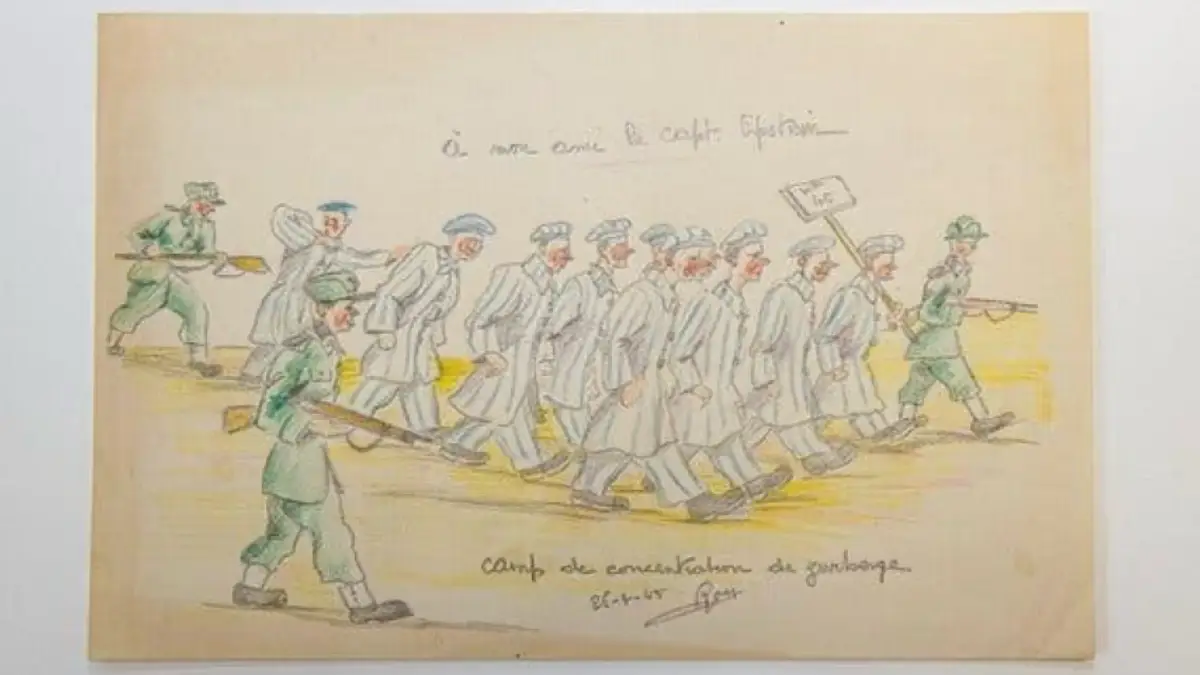
The drawings, now on display at Manhattan University, were found in a house in Westchester County.
Credit…Marcel Rous; via Manhattan University, Anissa Latif
By JAMES BARRON, New York Times, March 31, 2026. Click for full report.
If no one had noticed a leather satchel that had been forgotten in a closet — if the satchel had been thrown out — an art exhibition that opened last week could not have happened.
In the satchel were more than 20 chilling sketches — a man in a prisoner’s uniform being beaten, prisoners amid the emaciated bodies of other prisoners, prisoners in a line
The sketches are from a concentration camp at the end of World War II, the work of someone who survived: a member of the French Resistance named Marcel Roux. They are on display at the Holocaust, Genocide and Interfaith Education Center at Manhattan University, a Lasallian Catholic institution in the Bronx.
The university said the story behind the exhibition started in 1993, when Kenneth and Helene Orce bought a house in Westchester County. The seller was Ruth Epstein, a widow whose husband, William Epstein, had been an Army doctor in World War II. William Epstein, who was later an obstetrician and gynecologist at Mount Sinai Medical Center in Manhattan, died in 1990.
The Orces renovated, as new owners do. In a closet they found the satchel. It was apparently William Epstein’s from the war. The only marking on it was a piece of tape with the words “Capt. Epstein — Please Return 20 Field Hosp.”
The bag had been left behind when Ruth Epstein moved out. The Orces asked whether she wanted it. She did not.
The bag contained the sketches, a few postcards and photographs of beaches, buildings and American military aircraft, along with two handwritten notes to her husband and some newspaper clippings.
Years later the Orces emailed images of the sketches to an official with the Holocaust art archive in the museum division of Yad Vashem, Israel’s official Holocaust memorial center, who said that the drawings were the work of Roux, who had been held at the Langenstein-Zwieberge camp in Germany in the days after it was liberated by the U.S. Army.
The Orces gave the sketches to Manhattan University; Kenneth Orce, a retired lawyer, is an alumnus.
“The sketches Roux did are really the story of living in the camp, given as a gift to Captain Epstein,” said Mehnaz Afridi, the director of the Holocaust, Genocide and Interfaith Education Center. “He wanted to put everything in a visual representation of what had happened to him. What’s amazing is that he made these sketches really quickly.”
But mysteries accompany the sketches. Who was Roux?
Afridi said that he had been a member of the French Resistance, as was his wife. A paper prepared for the exhibition said that Roux, who was 41 when the war ended, was not Jewish. But he spent nearly three years in Sachsenhausen, a concentration camp north of Berlin, before he was moved to Buchenwald in early 1945 and then to Langenstein-Zwieberge, a subcamp.
“Roux was not a professional artist in the conventional sense,” the paper for the exhibition said. “His artistic production appears to have been limited, private and shaped entirely by the circumstances of his imprisonment.” He apparently had no formal training in art.
Afridi mentioned another mystery. “He used colored pencils, and the paper is lined graph paper, we would call it today,” Afridi said. “Where did he get the paper? Where did he get the pencils.