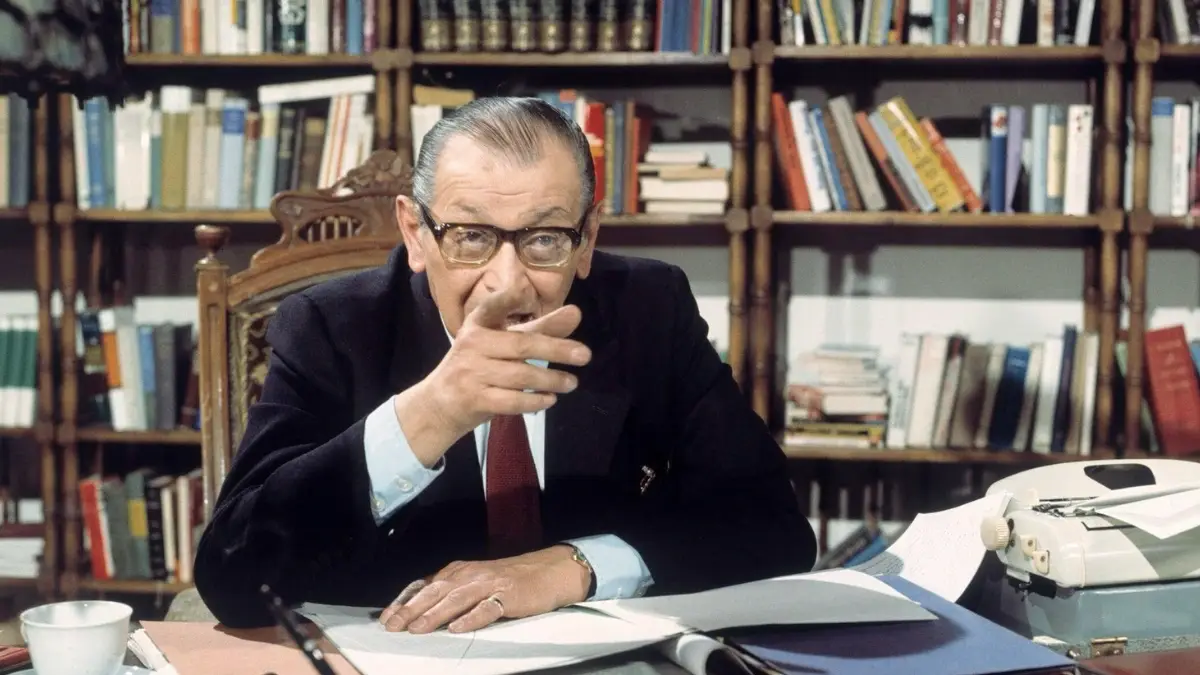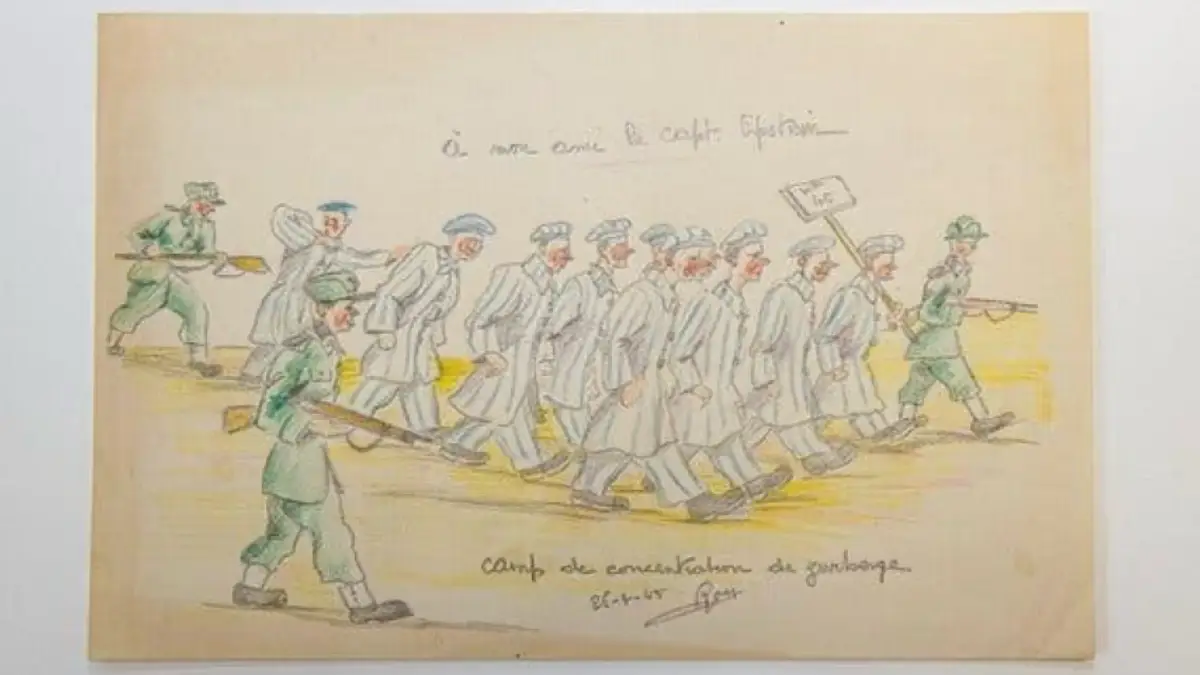
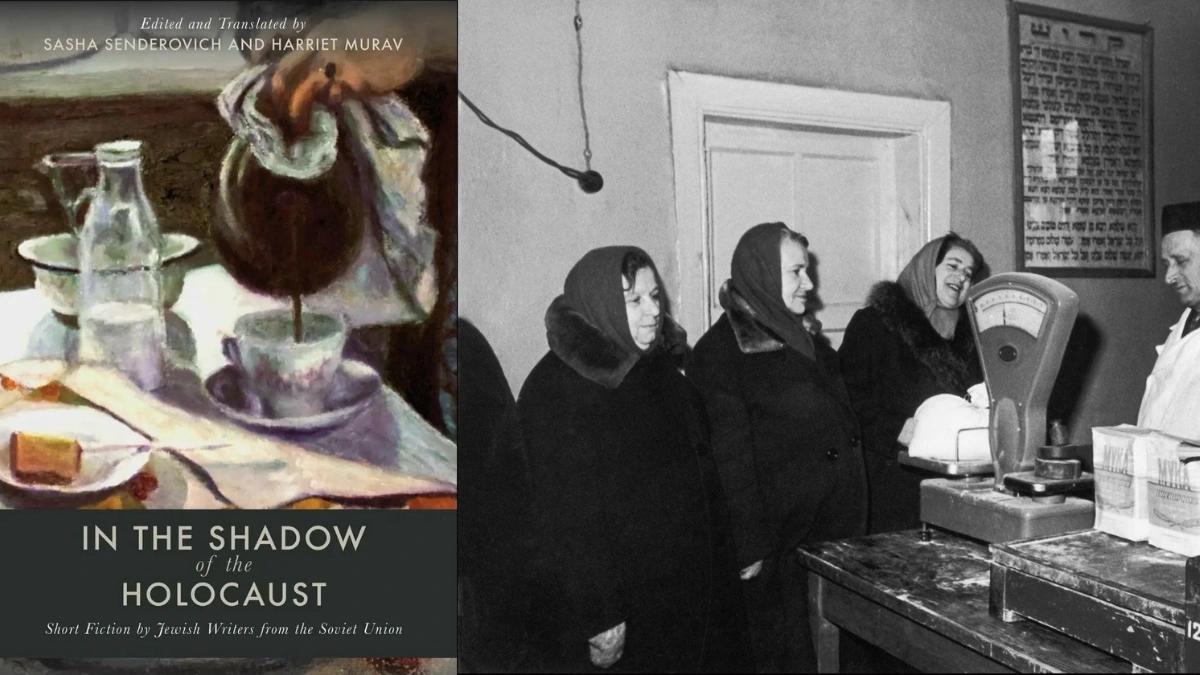
The book “In the Shadow of the Holocaust” showcases Jewish literature written in the Soviet Union; at right, Jewish women buy flour before Passover in Moscow in 1965. (Keystone-France/Gamma-Keystone via Getty Images)
The writer Sasha Vasilyuk interviews the translators behind “In The Shadow of the Holocaust.”
By Sasha Vasilyuk, Jewish Telegraphic Agency (JTA), February 20, 2026. Click for full report.
The usual perception of Soviet Jewish literature after World War II is that there was none. The conversation around the decades after the Holocaust usually focuses on the refuseniks and large waves of emigration away from a place with a history of suppressing its Jewish minority.
A new collection of translated short stories by Soviet Jewish writers, originally published in the USSR in Russian and — mind-blowingly — in Yiddish, challenges that view. For someone who grew up in Ukraine and Russia not knowing much about my roots because my Jewish grandfather remained silent on the subject of anything Jewish, I read “In the Shadow of the Holocaust” with a thirst I didn’t know I had.
In these 10 stories by seven authors, Jewish survivors are dealing directly with the ruins of a world that is no more. Unlike their American counterparts, however, they continue making a life in the proximity of the tragedy, among cemeteries and unmarked ravines. And despite the whims of their socialist empire, they don’t stay silent.
I sat down with the book’s translators — Sasha Senderovich, a professor in the Slavic department of the University of Washington, and Harriet Murav, professor emerita at the University of Illinois — to ask them what these texts reveal about our understanding of the Jewish experience.
What inspired this project?
Harriet Murav: There is a perception in the educated reading audience that there’s really nothing about the Holocaust from the former Soviet Union. Unless you give people something to chew on, it’s hard to convince people. Our motivation was to provide the general reading audience and the college undergraduate audience with something to read.
Sasha Senderovich: Part of the project of the book was to show this was in plain sight. In several cases, the stories that were originally published in Yiddish were also published in the Russian translation, which further tells us they were accessible not just to Yiddish readers, but to a broader public.
I too had been under the wrong impression that Yiddish, both spoken and oral, disappeared entirely in the post-war period. Did you know about the existence of Yiddish writing in the USSR growing up or did you discover it as academics?
SS: Growing up, I don’t think I had much awareness of spoken Yiddish. The last person in my family to be a native speaker was my great-grandmother. She died when I was 13, but I don’t remember her speaking Yiddish to me. But then in the late 1980s-early ’90s, there was quite a bit in the general cultural sphere. I remember going to the movie theater in Ufa to watch a two-part film on “Wandering Stars,” Shalom Aleichem’s novel. I have a distinct memory of seeing the title card where the Russian letters are stylized to look like Hebrew. Another strong memory from the early 90s is watching “Ladies’ Tailor” on TV in Russia with bits of dialogue in Yiddish.
What about you, Harriet?
HM: My father was a native speaker of Yiddish. I didn’t grow up speaking it in northern New Jersey, but it was part of our world. In terms of the former Soviet Union, through Russian translations of Yiddish works held at the University of Illinois in the Bank Champaign Library, I became aware of the proliferation of Yiddish literature in the Soviet Union and its translation into Russian. I wandered around the stacks and there were all these little signs “translated from Jewish.”
In the opening story by David Bergelson, an old Jew recounts his sole survival in an extermination camp near Lviv to a Yiddish-Russian translator and says, “The suffering was in Yiddish.” Can you paint a picture of how the slaughter of Jews was or wasn’t talked about in the USSR?
HM: Pravda and Izvestiya [Soviet newspapers] reported on the Nuremberg trials in excruciating detail every single day. You could read about all the horrors of the death camps, with huge long articles with photographs. It’s true that [perished] Jews were called “peaceful Soviet citizens”, but I’m convinced that after you see that 10 times and it’s about a ravine somewhere outside a city, you know that it means Jews. So there was literature published in Russian about death camps and ravines and shootings and perpetrators and collaborators. But you sort of had to have eyes to look.
Even if it wasn’t in a Soviet school textbook, it wasn’t in my U.S. school textbook either. When I was in high school in the 1970s, there were four lines about the Holocaust. We did not read “The Diary of Anne Frank.” We did not discuss the murder of Jews.
SS: In the 1920s and ’30s, there were many Yiddish journals in the USSR. There was a period of repression starting in the late ’40s and then things came back around in the late ’50s with the publication of Ilya Ehrenburg’s short novel “The Thaw” that’s very specifically about Jews and the centennial of Shalom Aleichem, with the publication of the famous six-volume edition of his work that every Jewish family had on their bookshelves. The Yiddish journal Sovetish Heymland, which published many of the stories we chose, came out of this revival and became a monthly in 1965.
HM: It didn’t just have articles. Inside the cover it had lessons on how to learn Yiddish. Also, every issue had English language summaries of the contents because people subscribed to it in the U.S. and Israel.
Fascinating! What do you think is different about capturing the Holocaust when you’re in the safety and remove of other continents versus when you’ve remained living nearby, where cemeteries and mass graves became part of the landscape, but where life also continued and brought with it new problems?
HM: I don’t know how I would be if I continued to live in the places in which these things happened. When I was researching something in Kyiv, I went to the cinema and photography archive and they said, “Oh you’re interested in the genocide? We have a film you can watch.” And it was a graphic depiction of the act of killing of a very pregnant woman. I ran out of there and went home and must have taken 10 showers and started scouring how fast can I get out of here? So there is a huge difference between being at home and crying because you’re immersed in this literature and actually living there. White Americans don’t live with history the way most of the rest of the people in the world live. And I don’t know how I would do it.
SS: The strangeness and the uniqueness of these stories is that sense that you cannot be far from where the atrocities have occurred and life goes on in some way that incorporates those ruins.
HM: I also think that the American way of life and death is quite distinct. We are very separated from death. For [Itsik] Kipnis, for example, in his earlier work published in the 1920s, going to visit the cemetery was just part of daily life. So there is a way in which the presence of the dead, not the murdered dead, but the dead who died of their own deaths, was much more vivid, even in traditional Jewish life, than it ever was in this country. And we particularly isolate ourselves from suffering and death, let alone mass violence.
In your recent essay for LitHub, you argue that “to insist on the Holocaust’s uniqueness as a shield against comparison risks turning it into an exception that cannot illuminate anything beyond itself, and that cannot, therefore, speak meaningfully to the present.” How did the recent wars in Ukraine and Israel/Gaza influence your work on this book?
HM: What we have is another book about what happened to Jews a long time ago. Another book about the Holocaust. And I feel badly about that because I don’t want to be saying that this is the only mass violence of our time and that somehow it’s paradigmatic and exceptional. In some ways it’s paradigmatic, but only because people use the propaganda and the devices of mass killing in their own genocides. What happened under German occupation? The ways in which resources were drained away from localities, the ways in which locals were gang-pressed into collaboration, the really powerful propaganda, the incompetence – these are all things we can observe today.
I mean, we are not scholars of genocide. We’re not historians. Scholars of genocide who’ve spent their entire careers working on genocide have called what’s happened in Gaza genocide. We won’t even speak of what’s happening in Sudan. So I think we both feel very strongly that relativization does not necessarily follow from rendering these events in terms that invite comparison.
SS: To the extent that these stories deal with continuing to live where destruction happened, the same question is on my mind as I watch Gaza and the discussions about what happens to the people who live there. These are not hypothetical questions. And they were not for the people who were writing these stories.
Sasha Vasilyuk is the author of “Your Presence is Mandatory,” the winner of the 2025 Sami Rohr Prize for Jewish Literature.
The views and opinions expressed in this article are those of the author and do not necessarily reflect the views of JTA or its parent company, 70 Faces Media.