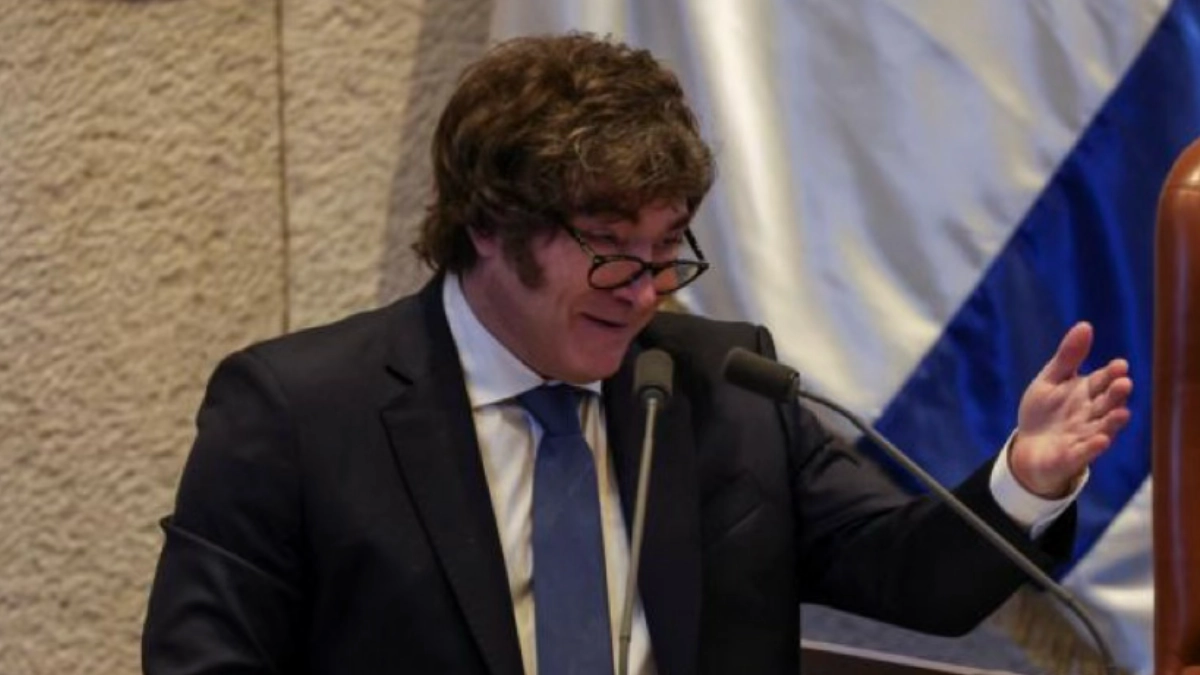
Argentine President Javier Milei speaks during a Plenum session of the Knesset, Israel’s Parliament, in Jerusalem, June 11, 2025. Photo: REUTERS/Ronen Zvulun
By Shiryn Ghermezian, The Algemeiner, March 20, 2026. Click for full report.
Argentina assumed the presidency of the International Holocaust Remembrance Alliance (IHRA) on Wednesday during a handover ceremony held at Palacio San Martín in Buenos Aires.
The appointment marks the first time that a country from South America will chair IHRA — an intergovernmental organization comprising dozens of countries including the US and Israel — and host its plenary meetings.
For more than 20 years, Argentina has been a member of the IHRA, whose goal is to strengthen, advance, and promote Holocaust education, remembrance, and research worldwide. It was founded in 1998 and has 35 member countries.
“The IHRA now crosses the equator for the first time in its history,” IHRA Secretary General Michaela Küchler said on Wednesday. “This is more than a geographic milestone. It is a reminder that the responsibility to remember the Holocaust and the genocide of the Roma belongs to the whole world.”
The Argentine presidency will take place under the theme “Expanding the Frontiers of Remembrance,” which will highlight the commitment to broadening the reach, both geographically and conceptually, of Holocaust remembrance, education, and research. IHRA said one of Argentina’s “priorities” during its presidency will be to bring the organization “closer to Latin America and to facilitate greater access to Holocaust archives.”
Presidency of the IHRA lasts for one year. Israel held presidency from March 2025 to February 2026 under the theme “Crossroads of Generations,” which emphasized the responsibility of passing down Holocaust remembrance from survivors to future generations.
More than 5,000 Holocaust survivors arrived in Argentina after the World War II, making it the home to one of the largest communities of Holocaust survivors in South America, according to IHRA. Roughly 150 survivors live in the country now. In 2020, the government adopted the IHRA definition of antisemitism.
Argentine President Javier Milei has been a longtime supporter of Israel and spoke about his dedication to the Jewish community and the Jewish state at The Algemeiner J100 Gala earlier this month, where he was honored with the Warrior for Truth award.
Argentine businessman Marcelo Mindlin will serve as IHRA chairman with the support of Argentina’s Ministry of Foreign Affairs, International Trade, and Worship.
“All governments, of various political backgrounds, have agreed on the need to be part of the IHRA for over 20 years and to develop education and memory policies regarding the Holocaust; there is no doubt that this genuine state policy is what has contributed to President Milei’s valuable decision to assume this presidency,” said the incoming IHRA chairman. “A clear example of this enduring construction is the adoption of the IHRA working definition of antisemitism by the Argentine state and judicial bodies, as well as by civil society organizations and other public agencies. It is a crucial tool for combating antisemitism, and our country can proudly demonstrate the success of its implementation.”
“As the voices of survivors grow fewer and distortion forces loom larger, our collective responsibility grows greater,” said outgoing IHRA Chair Dani Dayan. “Israel’s presidency led the IHRA toward significant strides in meeting that challenge — adopting new educational tools and launching global initiatives to strengthen engagement with younger generations and to fortify the status of the Holocaust remembrance community. I thank our partners across the IHRA and am confident that Argentina will continue to advance our vital mission in the year ahead.”
Beyond Holocaust remembrance, IHRA is perhaps best known for adopting a “working definition” of antisemitism in 2016. Since then, the definition has been widely accepted by Jewish groups and lawmakers across the political spectrum, and it is now used by hundreds of governing institutions, including the US State Department, European Union, and United Nations.
According to the definition, antisemitism “is a certain perception of Jews, which may be expressed as hatred toward Jews. Rhetorical and physical manifestations of antisemitism are directed toward Jewish or non-Jewish individuals and/or their property, toward Jewish community institutions and religious facilities.” It provides 11 specific, contemporary examples of antisemitism in public life, the media, schools, the workplace, and in the religious sphere. Beyond classic antisemitic behavior associated with the likes of the medieval period and Nazi Germany, the examples
include denial of the Holocaust and newer forms of antisemitism targeting Israel such as demonizing the Jewish state, denying its right to exist, and holding it to standards not expected of any other democratic state.
Israel’s Foreign Ministry congratulated Argentina on assuming the presidency of IHRA in a released statement on Wednesday. “We are certain that under President Javier Milei, IHRA will serve as a vital force in combating Holocaust denial and honoring the survivors,” the ministry said. “In an era of rising antisemitism, this is more important than ever.”
US Secretary of State Marco Rubio said: “At a time of rising Holocaust distortion and denial, IHRA’s leadership is vital. We commend President Milei’s commitment to sharing truth and honoring survivors.”
Both IHRA plenary meetings during the Argentine presidency will take place in Buenos Aires, from June 1-4 and then Nov. 2-5. Each plenary will take place following a conference. On Nov. 1, a regional conference will take place where Latin American countries will gather to discuss Holocaust history and combating antisemitism in the region.
Argentina’s Minister of Foreign Affairs Pablo Quirno said assuming presidency of IHRA holds “special significance” for the country.
“It is not achieved by chance; it is the result of vision and political will,” he explained. “It reflects Argentina’s understanding that defending the memory of the Holocaust is part of a broader struggle — against falsehood, against fanaticism, and against all forms of moral degradation that threaten free societies. It is also an honor, as this is the first time a South American country has assumed this responsibility.”